Let Us Give Our Families the Gift of Tolerance For The Holiday Season

IMG_0136

Happy Holidays!
We say that phrase often during this time of the year.

Many of us attend, with our families, churches, synagogues, mosques, and other “places of worship” during the Holiday Season. Visiting these places of worship is a good thing, I guess–if it is more than a ritual or another box to check because we have been told we are supposed to do such.

Holiday Season 2014, many of us notice an undeniable undercurrent of unrest and intolerance in America, and other places of the world. Peace and civil discourse seem to be eroding, and some citizens believe they must take to the streets to be heard, acknowledged, and understood. Whether we are watching protests marches, vitriolic political campaigns, the frenzy over Ebola, viewing violent acts around the world, or interacting with persons in our community–one thing is sure–we need the gift of understanding and tolerance in our communities, cities, in America, and in many places in the world.

Like most fundamental orientations, the gift of tolerance probably begins in the smaller units of “family worlds”–in the conversations that parents have with their children and the examples they set when interacting with people who seem to be different from them.

From my perspective, there are at least a few basic essentials needed for giving the lifelong gift of tolerance that can be taught in our family worlds:

• Expanding the family’s knowledge base about other people, their lives, opinions and ethnic origins, by viewing them from numerous and historical perspectives. Do not assume….

•Treating other individuals and families as we would like others to treat us and our families (almost all organized religions profess this ethic of reciprocity).

•Gathering facts, from different perspectives, and discussing them in our families before rushing to generalizations or judgments.

So, Happy Holidays and spread the gift of tolerance in our families this season and into 2015. Such a gift will improve the well-being of all Americans, and it will be the gift that keeps on giving!
Learning for a Lifetime of Choices

Refined from President’s blog

mrrhv-kj_7670sm

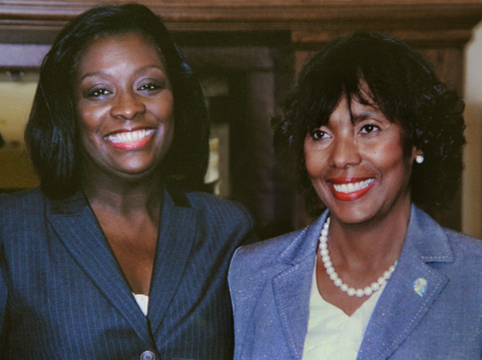
A little while ago, I had lunch with a childhood friend, Marlene.  We have been friends since we were both thirteen years old, and that has been decades ago. Our lifelong friendship began on the Southside of Chicago where we discovered personal commonalities, as we explored the public libraries together and devised many less intellectual adventurers.  On a Wednesday in November 2013,  we met in Union Station in Washington, D. C., and it was indeed a reunion of epic proportions.  Between the two of us there were four children–all with college degrees.    It was our prayer, and our spouses’ too, that we had prepared these talented young adults to lead responsible, worthwhile, and altruistic lives.

When we looked into each other’s faces, we bore witness to a half century of American societal forces that had shaped the lives, and choices of two women who grew-up with limited resources, but who dreamed of nearly endless possibilities.  My friend earned a MBA from a big ten university, and I earned a PhD from a top-ranked national university.  Besides the fact that both of us have done well, by American standards, we also gained so much more from our college experiences than the academic content and subsequent jobs.  The value of our higher education included exposure to options, consideration of diverse perspectives,  and development of skill sets beyond our imaginations.

As we seek to grapple with the finances surrounding colleges and universities, the debate about the value of colleges and universities has reached a louder pitch with proponents on all sides.   As states struggle with competing priorities for revenue, and the economic recovery continues, there is more concern about the value of a college education in relationship to the cost of attendance.  While nearly half of my college experience included the private and well-regarded University of Chicago, it still does seem possible for students to choose from a range of institutions which correlate, as closely as possible, with their family and financial support systems.

Now I know that from a lifelong learner and educator, much of what I think about the value of a college education could be discounted–since I liked learning so much–it did not occur to me to leave the college/university  structured community of learners.  However,  as my friend and I shared stories in Union Station, it also occurred to me how fortunate we have both been to have spent so much time learning from the perspectives of others,  and how our expanded worldviews had influenced the activities we engaged in with our children and probably the choices and lives of our children and their future grandchildren. It seems that an expanded worldview is in itself a legacy–possibly just as precious as an inheritance of a land estate.

Engaging in various structured classroom or hybrid learning experiences also seems to help build a sense of confidence in the learners.  Without a doubt this confidence can be gained from other experiences rather than a college experience, but the efficiency and sequencing of these experiences in a college environment might take years to acquire without the talented and caring professors serving as learning guides.

Thus, one value of colleges and universities, is that we offer options to assist learners enjoy a lifetime of choices and to leave a legacy of options.