April Showers Bring May Flowers and Hopefully Needed Clean Water for Global Neighbors

  535e752d752a6.preview-300
A good spring rain shower waters the trees, boosts water in lakes, cleans the streets, and sometimes soothes the spirit.  In fact, in many places, spring is one of the most beautiful times of the year, as we behold flowers opening, lawns greening, and the  beauty of the Earth unfolding.  As a kid, on the rainy spring days, I remember being reminded by my parents not to frown on rainy days because, yes, “rain showers bring May flowers.”  This statement was usually followed by “we need the rain!”  Without a doubt, water is one of the most basic necessities for life on our shared planet.
DSC_0208
Even though most of us know the significance of rain and the need for water to sustain our lives, many of us still view rain as a gift from the sky that will keep on giving.   Awareness of the need to sustain this valuable resource often only correlates with drastic climatic or pollution conditions that force us to plan and change our behavior to maintain sustainability.  Some environmentalists affirm that we are using water much faster than it is replenished. Other scientists have sounded alarms that global warming is producing profound changes in water availability, quality, and access. Thus, it is not a surprise that in some places in the United States a rainy day is a much appreciated day!  Like with many other limited resources, some states and municipalities are planning ahead strategically to maintain vital water resources.
20150324_usdm_home
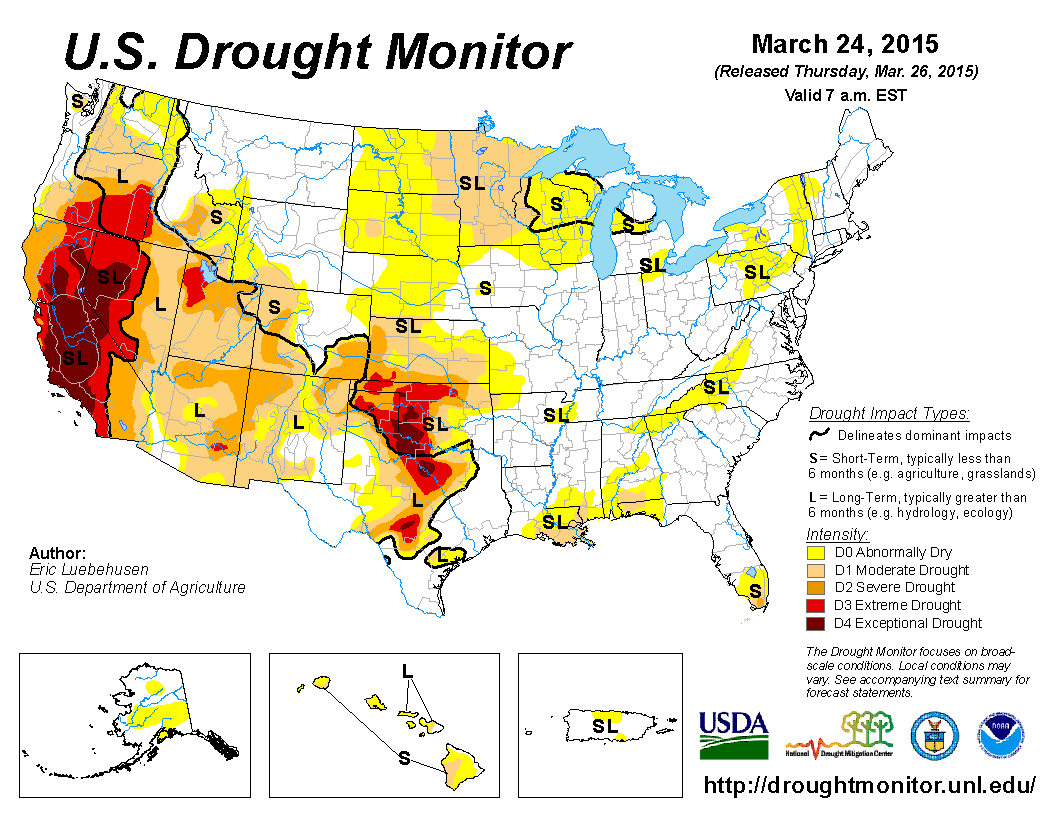
 As the USDA drought monitor map illustrates, there are states experiencing significant drought conditions in America.  Some western states with desert climates such as California are already engaged in a debate about the future of protecting water supply. Thus, not surprisingly, there are significant portions of America that employ water strategists and consultants to ensure that there will be adequate water for the citizens in the region.  According to some researchers, it is unclear whether droughts in some of the western states and adjacent areas are a new phenomenon or part of a cyclical rotation. Yet, issues regarding clean water possessions have social and economic effects for all of us.   Some urban planners project that protracted droughts in some parts of the US can lead to economic imbalances, as companies elect to locate in more verdant states.
 .
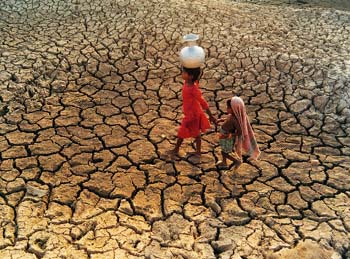
As my daughter, a fledgling environmentalist, recently reminded us, there is a great deal of drought in our global community that is literally a matter of life or death.  Even with the scarcity of water and drought protocols, many of us in America take clean water for granted.  We are usually only inconvenienced by monitoring our consumption and employing our sprinkler system on alternative days.  Yet, even with these practices, we function with limited knowledge about how the lives of our neighbors around the world are affected by lack of clean water.  Maybe if we knew more, we would engage in broader positive social action about managing water better among the Earth’s global citizens.
Most of us know that drought conditions can be linked to quality of life in many global communities.  The Bill and Malinda Gates Foundation monitors drought conditions in various global communities and supports drought relief efforts and water sanitation services through generous donations.  According to their Foundation website, drought can be devastating, resulting in barren fields, malnourished families, and starvation for millions of global citizens.  Likewise, the lack of clean water kills. The website charitywater.org states that:

“Diseases from unsafe water and lack of basic sanitation kill more people every year than all forms of violence, including war. Children are especially vulnerable, as their bodies aren’t strong enough to fight diarrhea, dysentery and other illnesses.”

So what does this mean for most of us?  As we calibrate our sprinkler systems, and pause to admire our flowers and green lawns, let us be cognizant that for some of our neighbors, even though some may be far away–water is a matter of life and death.  Sustaining our natural resources is one of the most important efforts we can engage in to sustain global communities and the well-being of future generations. I have been convinced that access to clean water is a social and environmental justice issue.  Helping global neighbors attain an improved standard of living might be viewed as a form of effective diplomacy.

 IMG_0285

 www.gatesfoundation.org

http://munchies.vice.com/articles/some-california-rice-farmers-would-rather-sell-water-than-plant-crops

 http://www.wired.com/2015/03/californias-run-water-act-now/

http://www.appalmad.org/slider/west-virginias-streams-are-in-trouble

Women’s History Month- Celebrating Our Leadership Talent Pool

women-in-business-conferences-e1374784551907

Women’s History Month presents an opportunity to reflect on (her)stories–nationally and globally. First of all, we have been fortunate in America to move towards a more enlightened and holistic sense of humanity because of the emergence of incomparable, iconic, and some internationally renowned women. Regardless of your current paradigm of what leaders should do to inspire and effect needed stability or change, it is easy to discern that there is something magnificently different, inspiring, courageous, and enthralling about extraordinary women who have risen to prominence in America.

As I reflect, it is hard to identify how a combination of intellect, authenticity, courage, charisma, personal backgrounds, and public appearance coalesces into women leaders who are fascinating and uplifting to watch. Nonetheless, there are, and have been, women visionaries who compel us to envision a better self and better world.  Each of us probably has a list of unforgettable women who helped shape our lives. And yes, there have been many men such as fathers, brothers, teachers, mentors who also helped shape and mentor us.  However,  this month we tell her stories.

Many of the women who have affected our lives seem to have had the courage to push past cultural expectations; to lead with their hearts and to engage the hearts of others; to employ their intellects to encourage intellectual development of generations; to broaden circles of interest about significant public issues to influence public policy; and to illustrate a grace under pressure that we can only applaud. As we think of, and pay homage to, these extraordinary women who accomplished the unexpected and possibly unthinkable while making it look easy, we also have to acknowledge that there are countless women who are not discoverable in historical accounts. For many of us, these women are unknown and obscure; yet, we are better humans because they were here. Thus, we should pay homage to all of them!

Recently, I began thinking about some of the women who helped me develop a broader view of leadership in higher education, to understand leadership from a woman’s perspective, and to embrace needed personal transformations and realities. Thus, I personally thank some authentic and incomparable women such as: the first African-American woman principal, former slave, and pioneering educator Fanny Jackson Coppin; activist and civil-rights leader Coretta Scott King; award-winning author, poet, and indomitable spirit Maya Angelou; Nobel Prize and Pulitzer Prize novelist Toni Morrison; anthropologist, museum director, and sister president Johnnetta B. Cole; higher education leader, President Molly Broad; Hall of Fame Coach C. Vivian Stringer; higher education educator, author, mentor, and former college president Gretchen Bataille; educator, former mentor, and former college president Bernice Miller; actress, singer, and late entertainer extraordinaire Pearl Bailey; selfless and inspirational Catholic school nuns; and of course, my late hardworking, nurse caregiver, supportive, and Southern mom, Dolores Batiste Howard.  These women with their ranges of perspectives and experiences have furnished a broad and diverse legacy from whence I have benefited.

When thinking of the contributions of these, and so many other women, it is easy to imagine that there is an expanded talent pool to elect a woman President of the United States with characteristics of some of our extraordinary American women. Of course, like many Americans, I want the most qualified,  future-oriented, and politically adept person to lead America. So maybe the time has come to broaden our pool of consideration to include some of those extraordinary women leaders of which America appears to have an abundance. A cursory glance of recorded history demonstrates that other countries have capitalized on the skills of women for national leadership roles. Although there are fewer Internet records of the lives or leadership characteristics of Queen Cleopatra (69-30 B.C.); Elizabeth I, Queen of England (1533-1603); Prime Minister Golda Meir; Prime Minister Indira Gandhi; or Prime Minister Margaret Thatcher, their feats as leaders have inspired and broken the perceived glass ceiling for generations of women around the world.

Women’s History Month is a good time to engage in positive actions that support women in our institutions of higher education, businesses, and communities so that we will broaden our pool of talent for potentially great, world leaders!